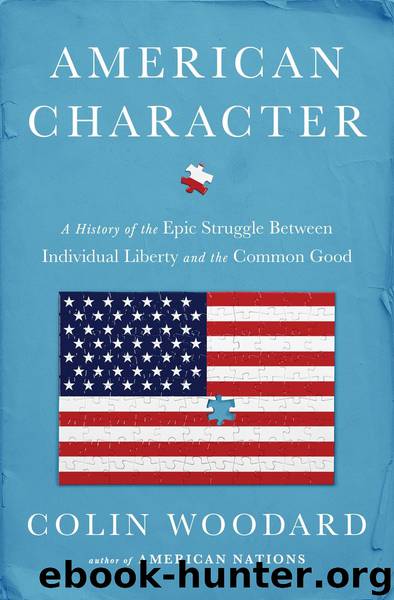
American Character by Colin Woodard
Author:Colin Woodard
Language: eng
Format: epub
Publisher: Penguin Publishing Group
Published: 2016-02-18T11:41:42+00:00
World War II ended the Great Depression almost overnight, as the Roosevelt administration transformed the country into a massive, government-run war machine that successfully waged battle on three fronts simultaneously; armed, supplied, and fed our allies; and helped vanquish three major industrial dictatorships, liberating hundreds of millions in occupied Europe and Asia. The United States emerged from the war as the richest and most powerful nation in the world, its key national liberal institutions not only intact, but now ingrained in the country’s political culture.
The war effort was centrally organized and guided, with the objective of drowning the Axis powers in a flood of ships, planes, tanks, rifles, bombs, bullets, and materiel. The new War Production Board converted established industries to military production, assigning tasks, priorities, and key resources; setting wages and prices; and banning the manufacture of nonessential consumer products like passenger automobiles, refrigerators, and nylon stockings. Government loans financed new plant construction and the expansion of existing facilities, while military procurement offices awarded contracts on a “cost-plus” basis, guaranteeing profits to private firms while the public absorbed all risk and expenses, including research and development. The Selective Service decided whose skills were needed on the production lines and whose on the front. Government rationing of meat, butter, coffee, and gasoline redistributed goods to the war effort. The Office of Scientific Research and Development drew universities into critical research programs, while the $2 billion Manhattan Project employed 150,000 to create the atomic bomb at huge new facilities powered by the New Deal–built Tennessee Valley Authority and Grand Coulee dams.15
Big business, which had formerly clashed with Roosevelt, enthusiastically partnered with the government. Massive privately owned factories and shipyards sprouted up almost overnight, churning out B-24s, jeeps, fighters, and cargo ships. Textile companies made parachutes, car plants built tanks and trucks, and typewriter manufacturers produced machine guns. Henry Ford’s Willow Run facility in Michigan, constructed in 1941, built eighty-five hundred medium bombers in three years, while Henry Kaiser’s sprawling California shipyard built a 440-foot-long, thirty-five-hundred-ton Liberty Ship in four days and fifteen hours, one of thousands of the cheap, mass-produced freighters assembled at yards on both seaboards. By 1944, the United States was producing 60 percent of the Allies’ munitions, and 40 percent of the world’s. By war’s end, it had produced twice as many tanks as Germany, and more than four times as many airplanes as Japan.
Unemployment ended almost instantly, with cost-plus contracts and round-the-clock operations yielding millions of well-paid jobs with plenty of opportunities for overtime. Competition for labor became intense, and to circumvent the restrictions of wage ceilings, many corporations offered health insurance, retirement benefits, and other perks, establishing an American model of employer-sponsored social welfare. (Henry Kaiser’s pioneering health management organization lives on today as Kaiser Permanente.) In the process, big business was rehabilitated in the public eye, its leaders seen as—and seeing themselves as—partners in the collective national project, rather than selfish guardians of privilege. (Even the War Production Board was headed by a business executive, Sears & Roebuck’s Donald Nelson.
Download
This site does not store any files on its server. We only index and link to content provided by other sites. Please contact the content providers to delete copyright contents if any and email us, we'll remove relevant links or contents immediately.
| Anarchism | Communism & Socialism |
| Conservatism & Liberalism | Democracy |
| Fascism | Libertarianism |
| Nationalism | Radicalism |
| Utopian |
The Secret History by Donna Tartt(19105)
The Social Justice Warrior Handbook by Lisa De Pasquale(12197)
Thirteen Reasons Why by Jay Asher(8921)
This Is How You Lose Her by Junot Diaz(6894)
Weapons of Math Destruction by Cathy O'Neil(6285)
Zero to One by Peter Thiel(5808)
Beartown by Fredrik Backman(5769)
The Myth of the Strong Leader by Archie Brown(5513)
The Fire Next Time by James Baldwin(5454)
How Democracies Die by Steven Levitsky & Daniel Ziblatt(5225)
Promise Me, Dad by Joe Biden(5157)
Stone's Rules by Roger Stone(5091)
A Higher Loyalty: Truth, Lies, and Leadership by James Comey(4967)
100 Deadly Skills by Clint Emerson(4932)
Rise and Kill First by Ronen Bergman(4797)
Secrecy World by Jake Bernstein(4756)
The David Icke Guide to the Global Conspiracy (and how to end it) by David Icke(4724)
The Farm by Tom Rob Smith(4517)
The Doomsday Machine by Daniel Ellsberg(4493)
